











Submit your info or message us on Zalo or Messenger

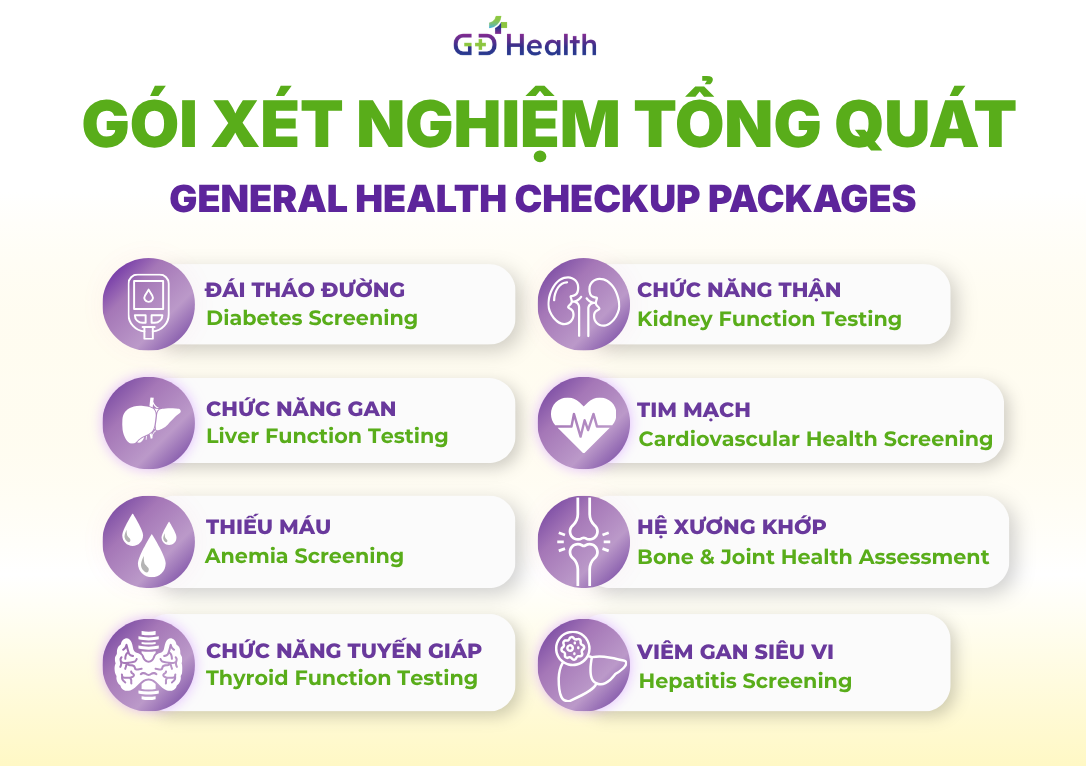

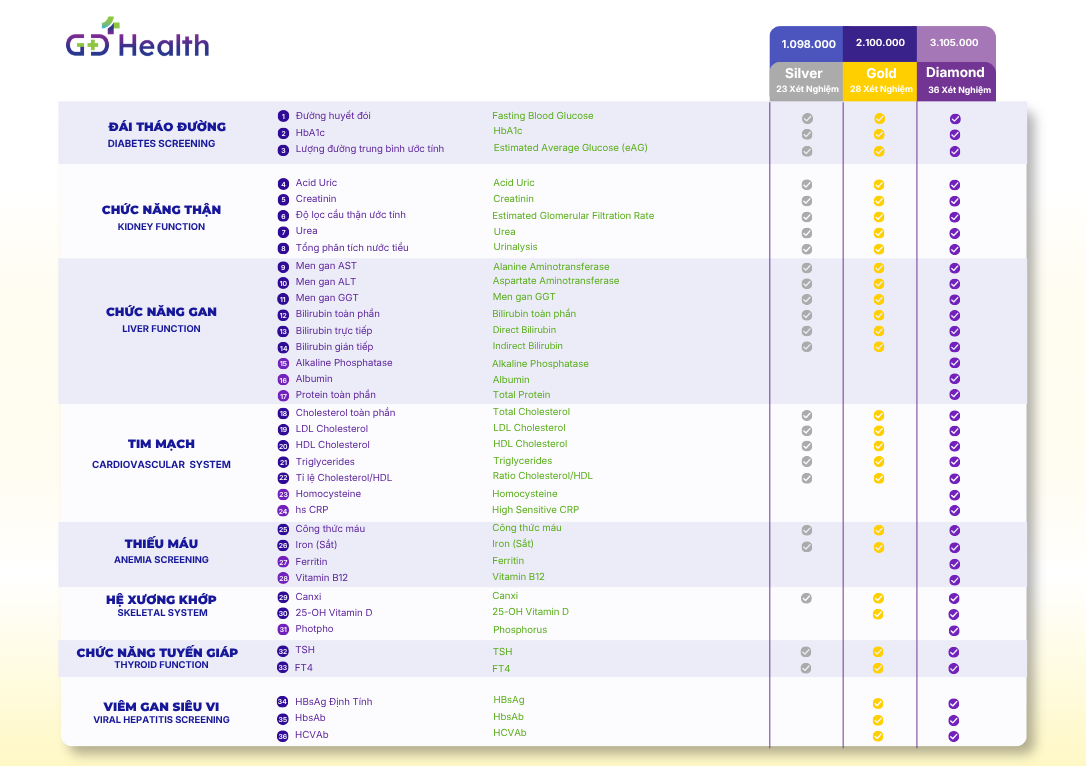
General Health Checkup – 36 Metrics
-
Free Consultation with a Healthcare Specialist
– Consultation available in Vietnamese & English, with a response within 2–3 minutes.
– Personalized testing packages based on your health status and needs, with test-result interpretation by medical experts.
- Fast & convenient: Samples can be collected at testing centers with 52 collection locations nationwide ➔, at home, or anywhere that is convenient and private for you.
- Complete privacy: Your personal information and test results are kept strictly confidential.
Health Checkup Packages
GD Health designs general health checkup packages to meet each individual’s health condition and needs:
- DIAMOND Package – 36 metrics
- GOLD Package – 28 metrics
- SILVER Package – 23 metrics
- Personalized Testing Package: Contact a GD Health Healthcare Specialist for a package tailored to your needs.
1. Diabetes Tests – 3 Metrics
Blood Glucose — This test measures blood glucose levels at the time of blood collection and reflects your immediate blood sugar status. Glucose levels are highly influenced by diet and physical activity, so fasting for 8–12 hours is often required. Blood glucose testing helps doctors quickly identify high or low blood sugar and is a key initial test for diabetes screening.
HbA1c — HbA1c reflects your average blood glucose level over the previous 2–3 months. One of its main advantages is that fasting is not required before the test, and the result is less affected by day-to-day lifestyle factors. HbA1c is an important test for diagnosing diabetes and assessing long-term blood sugar control.
Estimated Average Glucose (eAG) — eAG is calculated from the HbA1c result and converts the percentage value into familiar blood glucose units such as mg/dL or mmol/L. This makes it easier to understand your average daily blood glucose level and compare it with measurements from a home glucose meter.
2. Kidney Function Tests – 5 Metrics
Blood Creatinine — Creatinine is a waste product generated from muscle metabolism. It is filtered by the kidneys and eliminated through urine. Blood creatinine is an important marker of kidney filtration function and is also used to calculate eGFR.
Blood Urea — Urea is the final product of protein metabolism in the liver and is transported to the kidneys for elimination. Elevated levels may indicate impaired kidney filtration and waste removal.
Blood Uric Acid — Blood uric acid testing helps diagnose and monitor gout and assess the risk of uric acid kidney stones. Persistently elevated levels may also be associated with metabolic syndrome, cardiovascular disease, and reduced kidney function.
Automated Urinalysis — A rapid screening test evaluating urine pH, specific gravity, glucose, protein, red blood cells, and white blood cells. It can help detect kidney abnormalities, urinary tract infections, and metabolic disorders.
Estimated Glomerular Filtration Rate (eGFR) — eGFR estimates how efficiently the kidneys filter blood through the glomeruli each minute. Regular monitoring can help detect declining kidney function at an early stage.
3. Micronutrient Tests – 6 Metrics
Total Calcium — Helps assess calcium balance and supports evaluation of parathyroid disorders, bone diseases, and nutritional or absorption problems.
Serum Iron — Measures circulating iron and helps assess iron availability for red blood cell production. Low levels may be associated with iron-deficiency anemia.
25-OH Vitamin D (D3) — The primary blood test used to assess vitamin D status and determine whether levels are deficient, sufficient, or excessive.
Blood Phosphorus — Helps assess mineral balance and may be used to evaluate kidney function, parathyroid disorders, and bone metabolism.
Ferritin — A protein that stores iron inside cells. Ferritin testing is a useful marker for assessing the body’s iron stores and detecting early iron deficiency.
Vitamin B12 — Essential for blood cell production, DNA synthesis, and nervous system health. Testing can help identify B12 deficiency and related blood or neurological problems.
4. Liver Function Tests – 9 Metrics
Direct Bilirubin — Helps evaluate liver and biliary tract disorders, particularly cholestasis or bile duct obstruction.
Indirect Bilirubin — Helps assess bilirubin metabolism and red blood cell breakdown and may support evaluation of hemolytic anemia and bilirubin metabolism disorders.
Total Bilirubin — Represents the combined level of direct and indirect bilirubin and helps evaluate liver and biliary function.
ALT (GPT) — An enzyme found primarily in liver cells. Elevated ALT can indicate liver cell injury or inflammation.
AST (GOT) — An enzyme found in the liver, heart, muscles, kidneys, and brain. It can help assess liver health but is less specific than ALT.
GGT (Gamma-Glutamyl Transferase) — Measures an enzyme found primarily in the liver and is commonly included in liver and biliary assessments.
Alkaline Phosphatase (ALP) — Helps evaluate conditions involving the liver, bile ducts, bones, kidneys, and digestive system.
Total Protein — Measures albumin and globulins in the blood and provides information relevant to nutritional status and liver and kidney function.
Albumin — Measures a protein produced by the liver and is commonly used to assess liver and kidney function and nutritional status.
5. Cardiovascular Screening Tests – 9 Metrics
Triglycerides — Help assess the risk of cardiovascular disease, atherosclerosis, and acute pancreatitis, particularly when significantly elevated.
Total Cholesterol — Measures overall cholesterol and is a basic component of cardiovascular risk assessment and lipid screening.
HDL-C (High-Density Lipoprotein Cholesterol) — Commonly known as “good cholesterol,” HDL-C helps transport excess cholesterol back to the liver.
Non-HDL Cholesterol — Represents cholesterol carried by potentially atherogenic lipoproteins and can provide a broader assessment of cardiovascular risk.
LDL-C (Low-Density Lipoprotein Cholesterol) — Commonly known as “bad cholesterol.” Elevated LDL-C can contribute to atherosclerotic plaque formation.
Total Cholesterol/HDL Ratio — Reflects the balance between total cholesterol and protective HDL cholesterol.
High-Sensitivity C-Reactive Protein (hs-CRP) — Measures very low levels of C-reactive protein and can help assess low-grade inflammation and cardiovascular risk.
Homocysteine — An amino acid produced during protein metabolism. Elevated levels may be associated with cardiovascular disease and other health risks.
6. Thyroid Function Tests – 2 Metrics
TSH (Thyroid-Stimulating Hormone) — One of the most sensitive screening tests for thyroid function. Elevated TSH may suggest hypothyroidism, while low TSH may suggest hyperthyroidism.
FT4 (Free Thyroxine) — Measures the unbound form of thyroxine and is commonly tested together with TSH to assess thyroid function.
7. Hematology Test – 1 Metric
Complete Blood Count (CBC) – Automated Laser Analysis — Counts and classifies red blood cells, white blood cells, and platelets. It can help identify anemia, infection, blood disorders, and certain bone marrow disorders.
8. Hepatitis Tests – 3 Metrics
Automated HBsAg — An important initial test for determining whether a person is currently infected with hepatitis B virus.
Quantitative HBsAb — Measures antibodies against hepatitis B and helps determine the level of protection against the virus.
Automated HCV Ab — Screens for antibodies against hepatitis C. A positive result indicates previous or current exposure and may require HCV RNA testing to confirm active infection.
Frequently Asked Questions
How often should I have a general health checkup?
Adults aged 18–39: If you have no significant family history or major risk factors, a general health checkup every 2–3 years may be appropriate.
Adults aged 40 and above: A yearly health checkup is generally recommended.
People with underlying conditions or risk factors: Testing may be recommended every 6 months or as advised by your doctor.
What role does general health testing play in cancer screening?
Routine blood chemistry and hematology tests are not specific diagnostic tests for cancer. They can provide information about overall health and identify abnormalities that may require further evaluation.
Do I need to fast before a general health checkup?
For many important blood tests, fasting for 8–12 hours before blood collection may be recommended.
1. Why is fasting necessary?
Food can affect lipid levels, blood glucose, and certain other measurements.
2. How should I prepare?
Fast for at least 8 hours, ideally 10–12 hours. Plain water is allowed and encouraged. Avoid tea, coffee, soft drinks, milk, and carbonated beverages.
Medications: If you take medication for chronic conditions, consult your doctor. Unless otherwise instructed, medication may often be taken with a small amount of water.
Diet: Avoid excessive fatty foods, fried foods, and alcohol during the 24 hours before testing, as these may affect lipid results.
Xem thêm
Theo dõi
Đăng nhập
0 Góp ý
Cũ nhất